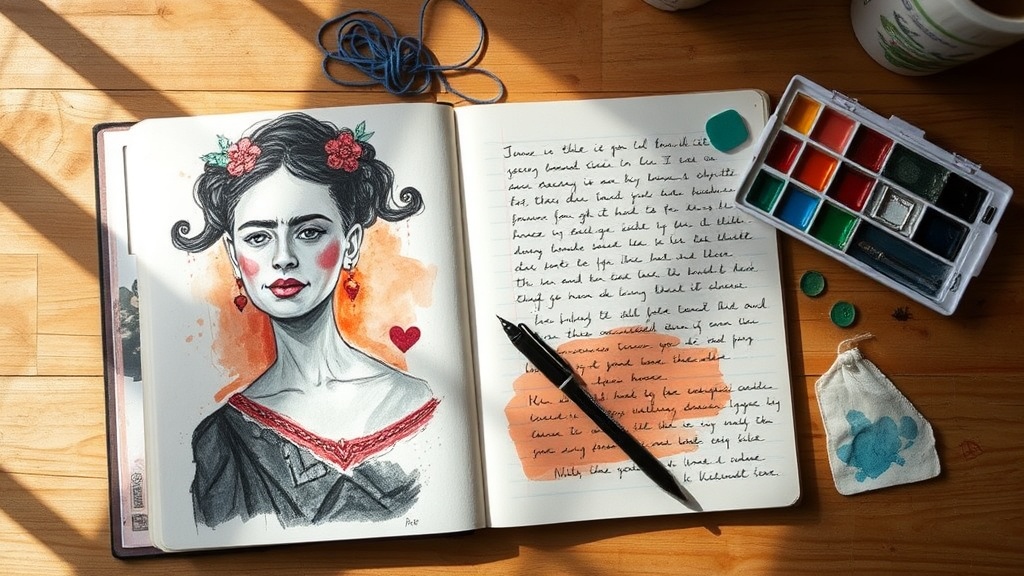
International Women's Day Art Journal With Me: Three Honest Pages to Claim Your Voice

This morning, on March 8, 2026, I pulled my journal onto the kitchen table before coffee and found a loose blue thread stuck to the cover.
It took me straight back to my babcia's apartment in Milwaukee: her teaching me to embroider tiny uneven flowers while daytime TV hummed in the background, her saying, "Don't start over. Just keep stitching."
My mom, a high school art teacher, gave me the same lesson in a different form. She let me absolutely destroy her summer supply closet. She cared about process first, cleanup second, perfection never.
When I found art journaling in college during a hard anxiety stretch, it clicked because it felt like both of them at once: my babcia's persistence and my mom's creative chaos. No audience. No grades. No polite version of my feelings.
That's why International Women's Day matters to my journal practice. International Women's Day is observed each year on March 8, and for me it's not a "theme day." It's a reminder that women have always had to claim space to tell the truth about their own lives.
The permission-givers
The pages we make now are connected to women who insisted on making work from the inside out.
Frida Kahlo: self-portrait as truth-telling
Frida Kahlo's self-portraits weren't vanity projects. They were survival documents. She painted pain, disability, heartbreak, desire, identity, and contradiction without tidying any of it up for comfort.
A line often attributed to her in translation is that she painted herself because she was the subject she knew best. Whether you've seen that exact wording in one source or another, the instruction still lands: start with what is true for you.
In journaling terms, Frida gives us permission to put our own face, body, and emotional weather on the page without apology.
Georgia O'Keeffe: inner experience over outside approval
People spent years trying to explain Georgia O'Keeffe's work through other people's projections instead of her own words. She kept painting from inner experience anyway: flowers, desert bones, sky, landforms, color as feeling. She refused to be reduced to an interpretation that erased her intent.
In journaling terms, that's the practice of trusting your own visual language. You do not need someone else to "get it" for it to be real.
Judy Chicago: art as collective voice
Judy Chicago pushed hard against art systems that excluded women and helped build collaborative projects where many hands, many techniques, and many stories mattered. She treated so-called domestic practices like embroidery, ceramics, and textile work not as lesser forms but as serious cultural language.
In journaling terms, she reminds us that private making and community making can coexist. A page can be intimate and still connected to a larger chorus.
Lynda Barry's framing still matters here too: drawing can be a thinking tool, not a performance metric. In journaling terms, the page is a place to process, not to impress.
Why art journaling is a feminist practice
If "feminist practice" sounds too academic for your kitchen-table notebook, here's my plain-language version:
- It values personal experience, especially the parts institutions tend to dismiss.
- It values process over product, which interrupts perfectionism and performance.
- It treats vulnerability as strength, not weakness.
- It gives your voice weight even when no one else will ever see the page.
Historically, women were often pushed toward the domestic and intimate while being told those realms were less important. Art journaling flips that script.
When you glue in a grocery receipt next to a hard sentence about burnout, that is not trivial. When you paint over a paragraph because the feeling changed overnight, that is not failure.
That is record-keeping for a life that counts.
Art journal with me: three guided spreads for today
These are intentionally low-cost. Use what you already have first, then improvise.
1) Self-Portrait Like Frida (budget-friendly)
Supplies
- Old magazine or printed scraps
- Glue stick
- Ballpoint pen
- One color medium (cheap watercolor pan, marker, or acrylic)
- Optional: mirror or selfie reference
Prompt
"Who am I today, not in general?"
Process
- Tear or cut a loose face shape from scrap paper and glue it down. Don't chase proportion.
- Add 3 symbols around the face that represent your current emotional state (weather icon, plant, object, animal, color block, anything).
- Write 5 short truths around the portrait. Keep them specific: "My shoulders are tense," "I miss my friend," "I need quiet tonight."
- Smear or wash one color over part of the writing so some words blur.
Messy-page note
If the face looks "wrong," keep it. Frida energy is honesty, not polish.
2) Abstract Color Study Like Georgia (budget-friendly)
Supplies
- Watercolor (or diluted marker/highlighter)
- Black pen or ink
- One cup of water
- Paper towel
Prompt
"What color is this feeling?"
Process
- Pick 2-3 colors that match your internal mood right now.
- Lay down soft abstract shapes: no objects, no symbols yet. Just movement.
- Let it dry for a minute, then add 6-10 simple ink lines that follow the contours of those shapes.
- In the margins, write one sentence that begins: "I don't need permission to…"
Messy-page note
If the colors turn muddy, name that. Muddy is also a feeling.
3) Community Page Inspired by Judy Chicago (use what's on hand)
Supplies
- One journal spread
- Pens/markers
- Optional: washi tape or stickers
Prompt
"What do we know together that I forget alone?"
Process
- Draw 3-5 open shapes on the spread (circles, squares, blobs).
- Invite friends, family, roommates, or coworkers to each fill one shape with a line, doodle, word, or symbol.
- Add your own marks between their contributions: stitches, arrows, color patches, connective phrases.
- Date the page and write one closing line about what surprised you.
Messy-page note
Collaboration is inherently uneven. That unevenness is the point.
If you're thinking "I'm not really an artist"
I hear this constantly, and I still feel it myself some days. Your journal is one of the few places where your creative voice does not need external validation to be real. You can make a page that is awkward, unfinished, and absolutely necessary. That's not a side benefit. That is the practice.
International Women's Day can be loud, branded, and performative in the wider culture. Your page does not need to be any of that. It can be quiet. It can be tiny. It can just say, "I'm here."
Sometimes that sentence is resistance.
A gentle invitation for today
If you want to journal with me today, set a 20-minute timer and pick one spread above. Don't plan the "best" one.
Light a candle if that helps. Put on a song. Let the page be honest before it is pretty.
This International Women's Day, give yourself the same permission these artists claimed: to fill a page with what's true.
I'll be at my table doing the same: paint on my hands, thread on my sleeve, and one-eyed Gesso supervising like a tiny art critic.