What to Do With a Journal Page You Hate (An 'Art Journal With Me' Process)

It happens to all of us. You sit down at your desk with your coffee, feeling that familiar pull to create. You open your art journal, lay down some color, maybe glue in a scrap of paper that caught your eye... and suddenly, it’s all gone wrong.
The colors are muddy. The composition is unbalanced. You try to "fix" it by adding more—more paint, more marks, more everything—until the page feels loud and overwhelming. You hate it. Your chest tightens with that familiar inner critic: Why did you think you could do this? You've ruined a perfectly good page.
This happened to me on Sunday morning. I was staring down a spread that looked like a chaotic accident in a paint factory. My first instinct was to rip it out. Just tear the paper from the binding and pretend it never happened. My second instinct was to grab the heavy white gesso and obliterate it completely. Start fresh. Hide the evidence.
But part of the reason I art journal—part of the reason I encourage you to art journal—is to practice staying in the messy in-between. To build the muscle of not running away when things get uncomfortable or ugly.
So, I took a breath. I left the room, refilled my coffee, and came back. This time, I decided not to fight the page, but to have a conversation with it.
Here is an honest look at what I did, step-by-step, to sit with a page I hated.
Step 1: Softening the Noise
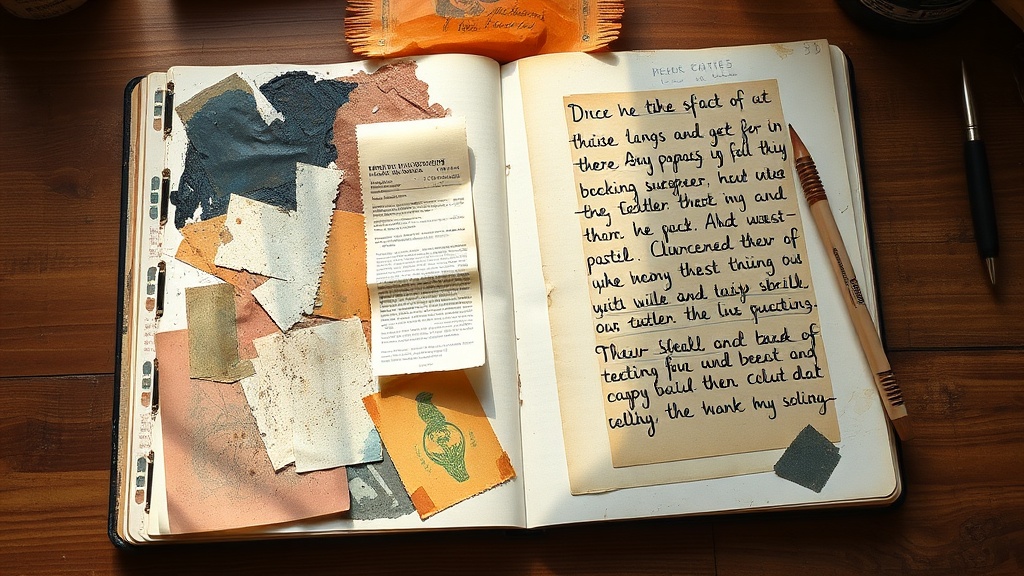
The main issue with my page was how loud it was. Neons clashing with dark, muddy browns. Instead of covering it with opaque gesso, I reached for some semi-transparent materials. I took a piece of tracing paper and tore it, letting the edges stay ragged. I glued it over the busiest section of the spread using matte medium.
Instantly, it felt like throwing a sheer curtain over a chaotic room. You could still see the history underneath, but the volume was turned down.
Step 2: Finding an Anchor
When a page is a mess, it often lacks a focal point. My eyes were darting everywhere. I dug through my little bowl of paper scraps and found a vintage receipt with beautiful, faded typography, and a small, muted botanical illustration cut from an old field guide.
I pasted them down right in the center. These elements became an anchor. A quiet place for the eye to rest amidst the storm of paint in the background.
Step 3: Journaling the Frustration
This is my favorite part. The page was still messy, still imperfect, and I was still feeling a bit frustrated with myself. So, I wrote about it.
I grabbed a black pen and started writing right over the dried paint, letting my handwriting be as messy as my feelings. I wrote: I don't know what this page is trying to be. I am feeling stuck. I want to rip it out, but I am choosing to stay.
There is something profoundly relieving about naming the struggle. The moment I wrote those words, the page stopped being a "failed artwork" and became a true journal entry. It was an honest reflection of where I was in that exact moment.
Step 4: A Wash of Compassion
To tie it all together, I mixed a very watered-down wash of Payne's Gray watercolor and gently brushed it over the edges of the spread, letting it pool around the collage pieces. The soft grey unified the jarring colors underneath and added a sense of quiet.
The Final Page
Is it my favorite spread I've ever made? No.
Is it going to win any awards for composition? Absolutely not.
But when I look at it now, I don't see failure. I see resilience. I see a moment where I chose patience over perfectionism. I see a visual record of me practicing self-compassion.
The next time you make a page you hate, please don't rip it out. Don't hide it. Let it be ugly. Let it be a mess. Add a layer of tissue paper, scribble your frustration in the margins, and close the book. The messy pages are the ones that teach us the most.