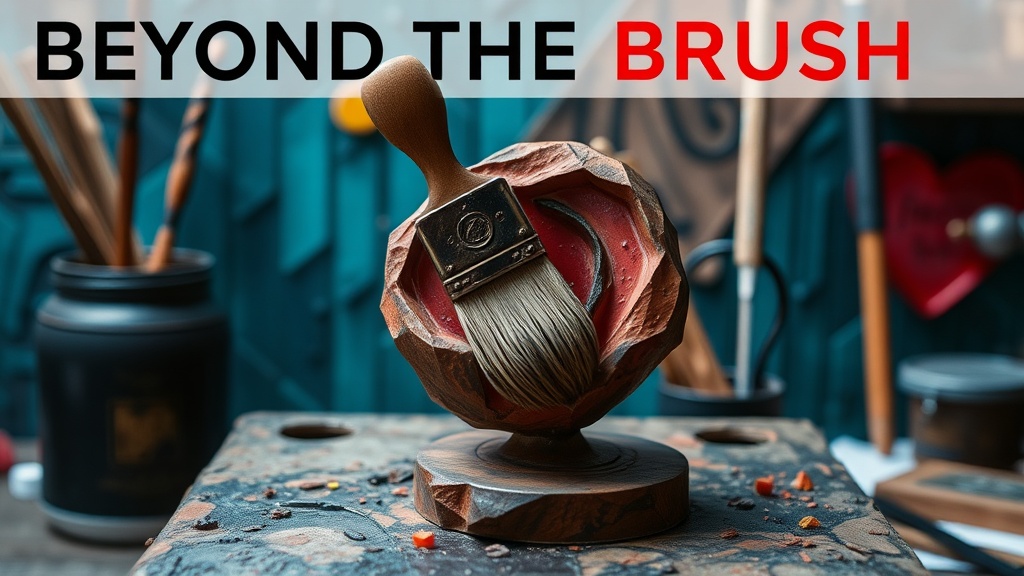
Beyond the Brush: 4 Unexpected Tools for Sculptural Painting

The Vintage Comb for Fine Ridges
Silicone Spatulas for Smooth Undulations
Natural Sea Sponges for Organic Pores
Textured Cardboard for Geometric Patterns
A palette knife glides across a thick layer of heavy-body acrylic, but instead of a smooth stroke, it catches on a jagged ridge of dried texture. A kitchen spatula scrapes against a canvas, leaving behind a rhythmic, serrated groove that a standard brush could never achieve. This is the moment where painting shifts from two-dimensional color application to a tactile, sculptural experience. When we move beyond the traditional paintbrush, we stop worrying about "perfect" lines and start engaging with the physical weight and topography of our art. Sculptural painting is about the dialogue between the medium and the tool, and often, the most profound breakthroughs happen when we reach for something that wasn't originally designed for the studio.
The goal of sculptural painting is to invite the viewer to touch the work—even if they aren't allowed to. It is a way to process complex, heavy emotions by physically building layers of resilience on the surface of your journal or canvas. If you find yourself stuck in a loop of "pretty" or "neat" art, it is time to introduce tools that demand a more visceral, messy, and honest interaction with your materials.
1. The Industrial Spatula and Masonry Trowel
Standard palette knives are excellent for fine detail, but they often lack the surface area required to move large volumes of heavy-body gel or modeling paste. If you want to create sweeping, architectural movements on your canvas, look toward the hardware aisle. A small masonry trowel or a flexible offset spatula used in baking provides a much broader, more authoritative stroke.
Using a metal offset spatula allows you to "plow" through thick mediums like Golden Heavy Gel Medium or Liquitex Modeling Paste. Unlike a brush, which absorbs moisture and loses its shape, the flat, non-porous surface of a spatula allows you to manipulate the medium without losing the structural integrity of your peaks and valleys. For instance, you can use the edge of a trowel to create sharp, geometric ridges that look almost like stone carvings. This technique is particularly effective when working with creating immersive gesso reliefs, as the tool can press the gesso into deep, permanent shapes before it dries.
Pro-Tip: When using a metal spatula, keep a jar of water or a specialized brush cleaner nearby. Metal can oxidize or pick up pigment residue quickly. To prevent your tool from becoming a "dirty" tool, wipe it clean with a damp rag after every single stroke to maintain the crispness of your edges.
2. The Sculptural Comb and Textural Rakes
Sometimes, the most beautiful textures are the ones that are repetitive and rhythmic. A standard brush is too imprecise for creating consistent, structural grooves, but a texturing comb or a heavy-duty garden rake can change the entire energy of a piece. This is where the "ugly" part of the process becomes essential; you aren't trying to paint a flower, you are trying to create a landscape of movement.
Imagine a thick layer of matte modeling paste spread across your surface. Instead of smoothing it out, take a wide-tooth comb or even a discarded piece of corrugated cardboard and drag it through the wet medium. This creates a sense of directionality. You can use a fine-tooth comb to create delicate, hair-like striations, or a heavy-duty rake to create deep, tectonic shifts in the surface. This method forces you to let go of the desire for control. You cannot "undo" a deep groove made by a rake; you can only work with the path it has carved.
Try this: Layer a translucent wash of acrylic ink over these grooves once they have dried. The ink will settle into the deep valleys created by the comb, highlighting the topography and giving your work a sense of aged, weathered depth. This creates a high-contrast visual that makes the sculptural elements pop against the flatter areas of the composition.
3. The Sculptural Brayer and Textured Rollers
While many artists use brayers for even ink distribution, the sculptural potential of a textured roller is vastly underrated. If you are looking to create a consistent, embossed-like texture across a large area, a textured brayer is your best ally. This is a departure from the "layering" mindset and moves into the "stamping" mindset.
Instead of applying paint directly to the canvas, try applying a thick layer of texture paste to the surface first. Once it is partially set, use a textured brayer to roll over the top. This compresses the medium into the crevices, creating a patterned, embossed effect that looks intentional and professional. You can use various types of rollers, from foam rollers to specialized pattern rollers found in craft stores, to introduce different levels of grit and grain. This is a wonderful way to break up a "flat" area of a journal page that feels stagnant or uninspired.
Experiment with: Using a foam roller to apply a thin, even layer of acrylic paint over a heavily textured surface. This ensures that the paint hits the "peaks" of your texture while leaving the "valleys" untouched, creating a sophisticated, multi-dimensional look that mimics the appearance of weathered stone or rusted metal.
4. Found Objects: The "Anything Goes" Approach
The most transformative sculptural tool is often the one you found in your junk drawer or outside in the garden. The beauty of a mixed-media practice is that it does not require a specialized kit; it requires a curious eye. When we move away from "proper" art supplies, we strip away the pressure to be "good" and instead focus on being "expressive."
Consider the following objects and how they can manipulate your medium:
- Old Credit Cards: The edge of a plastic card is perfect for scraping thin, sharp lines through wet paint or for "stippling" small dots of thick gel.
- Bubble Wrap: Pressing bubble wrap into a layer of heavy-body acrylic creates a repetitive, organic pattern that feels both structured and chaotic.
- Twine or String: Laying string into wet modeling paste and then painting over it creates raised, organic lines that look like veins or topographical maps.
- Sea Shells or Stones: Using the blunt edge of a stone to "stamp" or "press" into a wet surface adds an element of natural geometry that a brush simply cannot replicate.
Using found objects is an exercise in vulnerability. It requires you to trust your intuition rather than a set of rules. When you use a piece of torn cardboard to scrape through a layer of gold leaf and black acrylic, you are making a statement about the beauty of the mundane. You are telling yourself that the tools you have are enough, and that the "mess" you are making is a valid form of communication.
Embracing the Imperfect Surface
The transition from painter to sculptural artist requires a shift in mindset. You must stop viewing "texture" as something you add *on top* of a painting and start viewing it as the painting itself. The bumps, the ridges, the scrapes, and the gouges are not mistakes; they are the evidence of your presence in the work. They are the physical manifestations of the effort you put into your practice.
As you experiment with these tools, remember that the goal is not to create a pristine surface. The goal is to create a surface that feels alive. Whether you are using a heavy masonry trowel to carve out space or a piece of old twine to create organic pathways, you are building a sanctuary of texture. This tactile engagement is a powerful way to ground yourself when your mind feels scattered or overwhelmed. Let the weight of the medium and the resistance of the tools bring you back to the present moment.