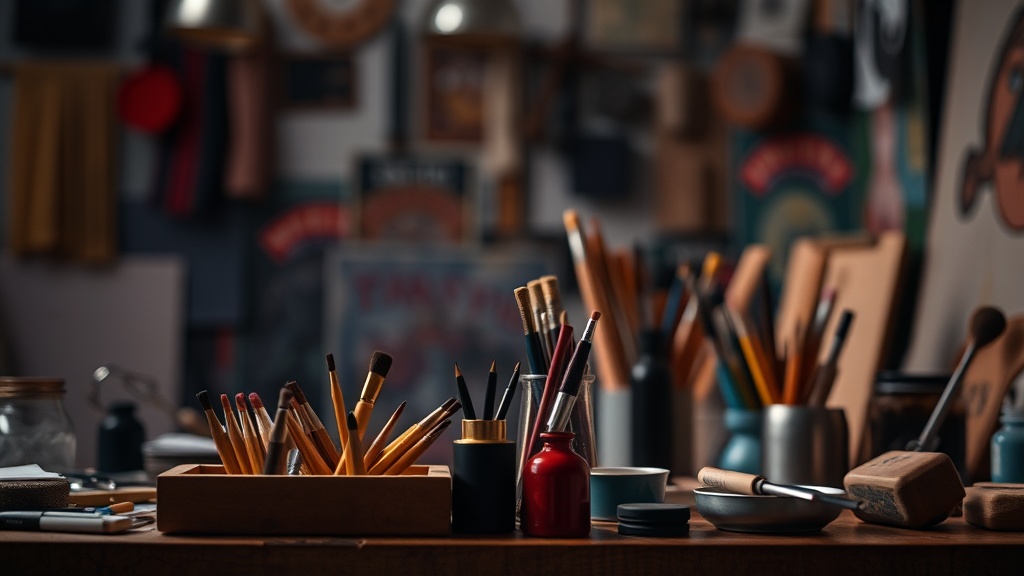
Why Your Art Supplies Are Not Reaching Their Full Potential

Organizing by Frequency of Use
The Importance of Proper Storage Temperatures
Cleaning and Maintaining Your Brushes Correctly
Rotating Your Palette to Prevent Drying
Studies in consumer behavior suggest that the average hobbyist owns nearly three times more art supplies than they actually use in a single year. This surplus isn't just a matter of wasted money; it is a psychological barrier to creativity. When your desk is covered in untouched tubes of heavy body acrylics, pristine watercolor pans, and expensive specialty papers, the pressure to use them "correctly" can paralyver your creative impulse. This post explores the five primary reasons your supplies are sitting idle and provides practical strategies to move from hoarding materials to making art through messy, intentional practice.
1. The Perfectionism Trap of High-End Materials
One of the most common reasons artists stall is the "preciousness" of their supplies. You might have a set of Winsor & Newton professional watercolors or a high-grade Moleskine sketchbook sitting in your drawer because you feel the medium is too expensive to "waste" on a bad drawing. This mindset is a direct enemy to a healthy creative practice. If you view your supplies as investments to be protected rather than tools to be used, you will naturally avoid the experimentation required for growth.
To break this cycle, you must intentionally practice making "ugly things" with your best materials. Try this exercise: take a high-quality piece of cold-pressed watercolor paper and intentionally create a mess using only water and a single pigment. Don't try to paint a landscape or a botanical study. Just watch how the pigment moves. By stripping away the goal of a "finished product," you lower the stakes. You are training your brain to see these expensive tools as part of a process, not just a means to a perfect end.
If you find yourself struggling to move past the initial fear of a blank page, you might benefit from unlocking creativity through daily sketching practice. The goal is to build the muscle memory of using your tools without the weight of expectation.
2. Over-Reliance on a Limited Color Palette
Many artists fall into the trap of using only the most "obvious" colors in their kits. You might have a massive set of 24 or 36 Dual Brush markers or a large palette of acrylics, yet you find yourself reaching for the same five shades of blue and brown every single time. This happens because your brain seeks the safety of what it knows, but it ultimately leads to stagnant, predictable work that feels uninspired.
To expand your use of your current inventory, stop looking at the labels on your tubes or pens and start looking at the color relationships. Instead of reaching for "Sky Blue," try mixing a custom shade using a deep ultramarine and a tiny touch of burnt orange. If you are working with gouache or acrylics, practice creating a "muddy" color on purpose. Learning how to create desaturated, complex neutrals will teach you more about color theory than any textbook. This helps you stop overthinking your color choices by giving you the confidence to trust your intuition rather than the label on the tube.
3. Neglecting the Importance of Surface Texture
A common mistake in mixed-media art is treating every surface the same way. Many artists buy various types of paper—from smooth Bristol board to heavy-duty Arches watercolor paper—but use them interchangeably with the same techniques. This lack of intentionality prevents you from seeing the full potential of your media. For example, using a fine-liner Micron pen on a heavy, textured watercolor paper can lead to frustration because the ink might bleed or the nib might catch on the tooth of the paper.
To maximize your supplies, you must match your medium to the specific topography of your surface. Consider these pairings:
- Heavy Body Acrylics on Canvas: Use a palette knife or a stiff hog hair brush to create physical texture and impasto effects.
- Liquid Ink on Smooth Bristol: Use this for high-detail, controlled line work that requires zero absorption.
- Watercolor on Cold-Pressed Paper: Use the texture of the paper to create "granulation" effects by letting the pigment settle into the valleys of the sheet.
When you treat the surface as a collaborator rather than just a background, your art gains a sense of depth and intentionality that flat surfaces cannot provide.
4. Fear of the "Messy" Intermediate Stage
In many art tutorials, you see the beginning (the sketch) and the end (the finished masterpiece). You rarely see the "middle," which is often a chaotic, unidentifiable smudge of wet paint and overlapping layers. This "ugly stage" is where most artists quit. If you are using mixed media—combining collage elements, acrylic mediums, and ink—the process is inherently messy. If you are afraid of losing control, you will never fully utilize your supplies.
A great way to combat this is to embrace the "destruction" phase of art journaling. Take a page that you feel is "ruined" by a mistake and instead of tearing it out, use a heavy layer of gesso or a large brushstroke of acrylic paint to cover it. This is not "fixing" the art; it is evolving it. By treating mistakes as a new layer of texture, you move away from the binary of "success vs. failure" and into a more fluid, vulnerable way of creating. This approach allows you to use your mediums—like heavy gel mediums or modeling pastes—to build up and transform rather than just paint over.
5. Lack of Tool Maintenance and Organization
It is difficult to feel inspired when your tools are in poor condition. A dried-out brush, a clogged ink pen, or a crusty palette is a physical manifestation of a stagnant practice. Many artists allow their supplies to degrade because they view maintenance as a chore rather than a part of the creative ritual. However, well-maintained tools change the way you interact with your art.
Implement these three practical maintenance habits to ensure your tools are always ready for a session:
- The Brush Reset: Never let acrylic paint dry in your brushes. Even if you are just taking a five-minute break, keep your brushes in a water jar or wash them immediately with a gentle soap like Dr. Brush or even basic dish soap.
- The Palette Cleanse: If you use a stay-wet palette for watercolors, ensure your damp paper is fresh. A moldy or overly saturated palette will ruin your pigment transparency.
- The Pen Test: Once a month, take your fineliners or brush pens and test them on a scrap piece of paper. If a pen is running low, don't throw it away; use it for "sketching only" to squeeze out the last bit of utility.
When your tools work predictably, you spend less time fighting your materials and more time listening to your creative intuition. A clean, organized workspace—even if it is just a small corner of a kitchen table—provides the mental clarity needed to dive into a deep, vulnerable practice.
"The goal of art-making is not to produce a beautiful object, but to engage in a beautiful process. Your supplies are the participants in that process, not just the tools used to finish it."
By shifting your perspective from "using supplies to make art" to "interacting with materials to explore yourself," you unlock a much deeper level of creativity. Stop worrying about the cost of the paper or the perfection of the stroke. Pick up the tool that scares you the most and see what happens when you let it be messy.