Watercolor Layering for Beginners: How to Build Depth Without Overworking Your Page

Watercolor Layering for Beginners: How to Build Depth Without Overworking Your Page
One of the questions I get asked most is: "How do you make your pages look so layered without making them muddy?"
Here's the honest answer: I've made plenty of muddy pages. Still do sometimes. But I've learned a few tricks that help, and I'm going to walk you through them.
The secret isn't fancy technique. It's understanding how watercolor actually works, and then giving yourself permission to experiment.
What You'll Need
- Watercolors — I use Koi ($12 at most art stores), but any student-grade set works. Seriously. The $3 sets from the dollar store even work if that's what you have.
- Brushes — One big brush (for washes), one medium brush (for details). Dollar store brushes are fine.
- Water — Two cups if you can manage it (one for rinsing, one for clean water), but one cup works.
- Paper — Your journal or sketchbook. If it's thin paper, it might buckle a little. That's okay. It's part of the charm.
- A pencil — Optional. You don't need to sketch first.
That's it. You don't need anything else.
The Three Layers of Watercolor Journaling
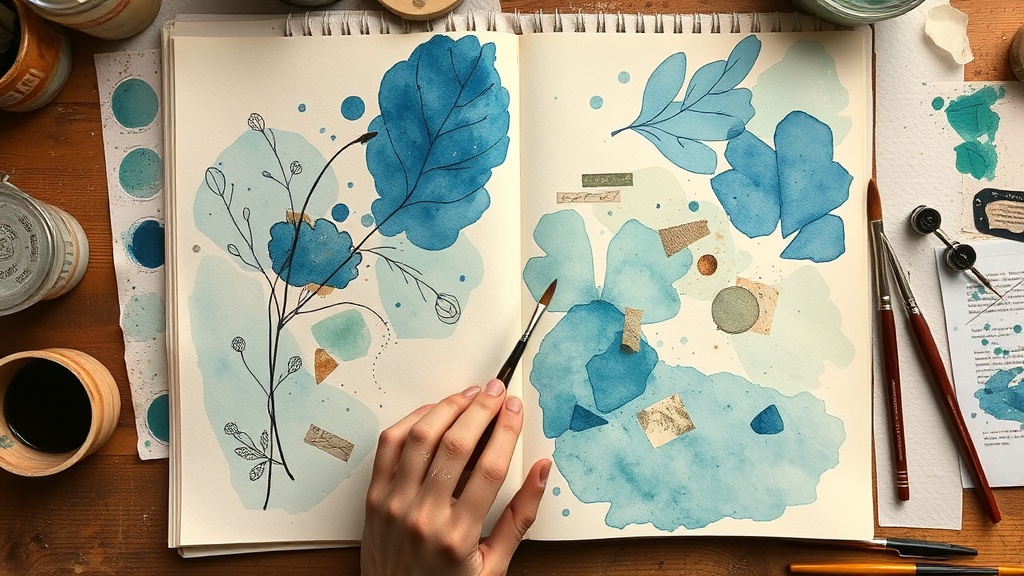
Think of watercolor layering in three stages. Each stage waits for the previous one to dry (or mostly dry). That's the whole secret.
Layer 1: The Wash (The Foundation)
This is your background. It's loose. It's wet. It's not precious.
How to do it:
- Pick 1-3 colors that feel right for your mood or theme. Don't overthink this. If you want blue and yellow, use blue and yellow.
- Wet your big brush with clean water.
- Dip it in one color and start painting across your page. Let the colors blend naturally where they meet. This is where the magic happens.
- If you want a second color, drop it in while the first is still wet. Let them marry together. Don't fuss with it.
- Let it dry completely. This takes 5-10 minutes depending on how wet you made it. Pro tip: Use a hair dryer on cool if you're impatient. It works.
What can go wrong:
- Your colors look muddy instead of blended. This happens when you mix too many colors together or when you keep touching it while it's wet. Solution: Stop touching it. Let it dry. A "muddy" wash is actually a beautiful neutral base for the next layer.
- Your paper buckles or waves. This is normal with thin paper. It dries flat. If it doesn't, you can press it under a heavy book.
- One color takes over and you don't like it. You're going to paint over it in the next layers. It's fine.
Layer 2: The Details (The Conversation)
Once your wash is dry, you add shapes, marks, or more color. This is where your page starts to feel like something.
How to do it:
- Look at your dry wash. What do you see? A landscape? An emotion? Just colors? All valid.
- With your medium brush, add shapes or marks on top. You can paint more defined areas of color, or you can add patterns, or you can write words. All of these count.
- You can use the same colors as your wash, or introduce new ones. Darker shades of your original colors often look beautiful.
- Let this layer dry before you add the next one.
Pro tip: If you want your details to look crisp (not blurry), make sure the wash is completely dry before you paint on top of it. If you paint on damp paper, the colors will bloom and blend into the wash. Sometimes that's beautiful. Sometimes it's frustrating. Knowing the difference is half the battle.
What can go wrong:
- Your new layer looks too dark or too opaque. Watercolor is transparent, so layering darker colors over lighter ones creates depth. If you want it lighter, use more water. If you want it darker, use less water.
- You're not sure what to add. Write words. Make marks. Draw shapes. There's no wrong answer here.
Layer 3: The Finishing Touches (The Emphasis)
This is where you add the small details that make the page feel complete. White gel pen. Darker marks. Collage. Whatever feels right.
How to do it:
- Once everything is dry, add your finishing touches. This might be white gel pen highlights, darker pen marks, or small collaged pieces.
- You can also add more watercolor at this stage if you want.
- The page is done when it feels done. There's no checklist.
What can go wrong:
- You add too much and the page starts to feel busy. Step back. Sometimes less is more. And sometimes you need to add more. You'll figure out what feels right.
The Thing About Muddy Colors
Let's talk about this because it's the thing that stops people from trying watercolor.
Muddy colors happen when you mix a lot of colors together, or when you keep painting over the same spot, or when you use colors that don't naturally go together. And you know what? Sometimes muddy is perfect. Sometimes it's the exact color you needed.
If you want to avoid muddy colors:
- Use 2-3 colors max in your wash (not 8)
- Let each layer dry before adding the next (wet-on-wet makes things blend and muddy)
- Use complementary colors if you want them to stay bright (blue + yellow = green, not mud. But blue + orange = mud. Know the difference.)
But honestly? I've made some of my favorite pages with muddy colors. They feel earthy and real and honest. Don't let perfect color stop you from making art.
A Simple Exercise to Practice
Here's what I want you to do:
- Open your journal to a blank page.
- Pick two colors that make you happy. That's it.
- Wet your page and drop those colors in. Let them blend. Don't touch it again.
- While it dries, make tea or step outside. Give it 10 minutes.
- Come back and add one more layer — a shape, some words, a pattern. Anything.
- Let it dry.
- Add one finishing touch with a pen or marker.
- Done.
That's a layered watercolor page. You did that.
The Real Secret
The thing about watercolor layering isn't technique. It's patience. Letting each layer dry before you add the next. Trusting that the process works.
It's also permission. Permission to make muddy colors. Permission to overwork a page. Permission to start over if you don't like it. Every page teaches you something.
I've been painting in my journal for five years and I still make pages that surprise me. Sometimes they surprise me because they're beautiful. Sometimes they surprise me because they're messy. Both are valid.
Your first layered watercolor page might not look like mine. It might look better. It might look completely different. That's the whole point.
Go make something. Your page is waiting.