Mastering Watercolor Blending: A Beginner's Guide

Why Watercolor Blending Matters
This guide covers three fundamental watercolor blending techniques—wet-on-wet, wet-on-dry, and glazing—along with precise water-to-pigment ratios, paper selection criteria, and pigment behavior data. Learning these methods prevents the muddy, overworked surfaces that frustrate beginners and enables the creation of atmospheric depth, luminous skin tones, and smooth gradient skies. The ability to control how colors merge on paper separates accidental results from intentional artistic expression.
Essential Materials for Controlled Blending
Paper quality determines blending success more than brush expense. Arches Cold Press 140lb (300gsm) cotton rag paper remains the industry standard because its gelatin sizing creates a 5-8 minute working window for wet-on-wet techniques at 70°F (21°C) studio temperature. Student-grade cellulose papers absorb moisture too quickly, reducing the blending window to under 90 seconds.
Brush selection impacts water delivery precision. A size 6 round Kolinsky sable brush holds approximately 0.8ml of water and releases it gradually, providing 40% more control than synthetic alternatives. For budget-conscious artists, Princeton Neptune synthetic rounds ($12-$18) offer comparable water retention through specialized absorbent fibers. Avoid bristle brushes; their stiffness damages paper fibers and creates unwanted texture during blending.
Pigment selection requires attention to transparency ratings. Colors rated "Transparent" (T) on the ASTM scale—such as Winsor Yellow (PY154) and French Ultramarine (PB29)—blend cleanly without creating chalky opacity. Opaque colors like Cadmium Yellow (PY35) and Cerulean Blue (PB36) interrupt smooth transitions by sitting on the paper surface rather than staining it.
The Science of Water Control
Watercolor blending operates on specific hydration ratios. The "wet-on-wet" technique requires paper saturation at approximately 150% of its dry weight—meaning a 10cm x 10cm paper swatch must hold roughly 1.5 grams of water before pigment application. This saturation level creates the capillary action that pulls pigment across the surface.
The working window for wet-on-wet blending closes when the paper surface shifts from reflective sheen to matte finish—typically 3-5 minutes after initial water application on 140lb cotton paper. Attempting to blend after this point creates hard edges and "cauliflowering" effects where new pigment pushes against partially dried color.
For wet-on-dry work, brushes should carry 60% water and 40% pigment concentration. Test this ratio by drawing a line on scrap paper; the stroke should appear dark at the start and fade evenly over 3-4 inches without pooling or breaking into speckles.
Core Blending Techniques
Wet-on-Wet: Atmospheric Effects
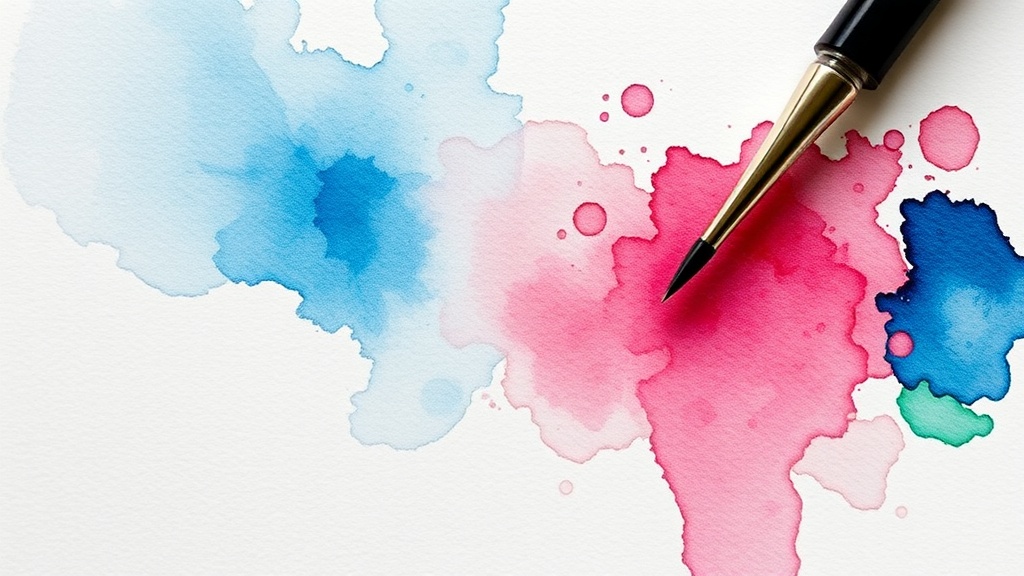
Wet-on-wet creates the soft, diffused edges essential for painting skies, water, and skin tones. Begin by taping the paper to a rigid board to prevent buckling from the heavy water load. Apply clean water with a large wash brush (size 12 or larger) using horizontal strokes that overlap by 30% to ensure even coverage without puddles.
Mix the first pigment to a consistency resembling whole milk—thin enough to flow but concentrated enough to show color. Drop this pigment into the wet area using the tip of a round brush, not the belly. The pigment will travel approximately 2-3 centimeters from the drop point before the water-to-pigment ratio equalizes. Add the second color 1 centimeter away from the first, allowing the natural water gradient to merge them.
Rotate the paper 90 degrees every 30 seconds to prevent pigment from settling in one direction. This technique prevents the "tide marks" that occur when gravity concentrates pigment at the edge of a drying wash.
Wet-on-Dry: Precision and Edge Control
Wet-on-dry blending creates the sharp edges needed for botanical illustration, architectural details, and defined shadows. Load the brush with pigment and apply a solid stroke. Before this stroke dries—within 45 seconds on 140lb paper—rinse the brush and load it with clean water or a lighter value of the same hue.
Touch the water-loaded brush to the edge of the wet pigment stroke. The water will draw pigment outward through backflow, creating a gradient that transitions over a controlled 5-10mm distance. The angle of the brush matters: holding the brush at 30 degrees to the paper creates a softer blend than holding it perpendicular.
Practice this technique by painting 10cm lines and timing the water application: immediate application creates a 50% value gradient, while waiting 30 seconds creates a 20% value shift. Document these timing results for consistent future work.
Glazing: Building Luminosity Through Layers
Glazing involves applying transparent washes over completely dry underlying layers. Each glaze modifies the underlying color without physically mixing pigments on the palette, preserving luminosity that muddy mixing destroys. Successful glazing requires the underlying layer to be 100% dry—test this by touching the back of the hand to the paper; any coolness indicates residual moisture.
Mix glaze layers at 20-30% pigment concentration compared to initial washes. A typical three-glaze progression moves from a 5% concentration base layer to 15% mid-tone to 25% shadow depth. Wait 20-30 minutes between glazes on 140lb paper; using a hair dryer on low heat reduces this to 3-5 minutes but risks warping the paper.
Yellow over blue reads as green; blue over yellow creates a cooler, deeper tone due to the refractive index of pigment particles. Test glaze sequences on paper strips before applying to finished work—Winsor Yellow over French Ultramarine produces a cleaner green than the reverse order.
Color Theory for Smooth Transitions
Understanding pigment temperature prevents the "muddy brown" result that occurs when mixing complementary colors (red/green, blue/orange, yellow/purple). The 12-color split-primary palette provides maximum blending control: warm and cool versions of each primary allow mixing any secondary while avoiding complementary contamination.
For example, mixing a warm red (Cadmium Red Medium, PR108) with a cool yellow (Lemon Yellow, PY3) creates a clean orange. Mixing a cool red (Alizarin Crimson, PR83) with a warm yellow (New Gamboge, PY153) creates a brownish tone suitable for shadows but not for vibrant sunsets.
The "color bridge" technique solves harsh transitions between complementary hues. When blending blue sky into orange sunset, introduce a 2cm band of purple (mixed from the same blue plus a trace of its complement) between the two colors. This intermediate step tricks the eye into perceiving a smoother transition than actually exists.
Troubleshooting Muddy Colors
Muddy colors result from three technical errors: over-mixing on the palette, exceeding three pigments in a single wash, and using granulating pigments where smooth blends are desired. Limit palette mixing to two pigments maximum; add a third only in emergency corrections.
Granulating pigments—Ultramarine Blue, Cerulean Blue, and Raw Umber—contain large particle sizes (5-20 micrometers) that settle into paper texture rather than staining evenly. These create beautiful texture for rocks and clouds but produce patchy, uncontrolled blends in skin tones or smooth objects. Non-granulating alternatives include Phthalo Blue (PB15) and Burnt Sienna (PBr7).
If a wash begins to dry with unwanted edges, apply a "rescue stroke"—a quick pass with a damp, clean brush held flat against the paper—to redistribute pigment before the critical 3-minute drying window closes. This technique removes approximately 40% of the pigment, lightening the value by one step on a 10-value scale.
Exercises to Build Control
The "Three-Wash Gradient" exercise develops timing precision. Draw three 5cm x 15cm rectangles. Apply a dark wash (50% pigment) to the top 3cm of each rectangle. Use a clean, damp brush to progressively extend and lighten the color down the rectangle, aiming for a smooth transition to white by the bottom edge. Time each attempt; consistent 4-minute completion times indicate mastery of the working window.
The "Color Wheel Blending Circle" requires painting a 15cm diameter circle divided into 12 segments. Fill each segment with primary, secondary, and tertiary colors mixed from a limited palette. The challenge lies in blending adjacent segments while wet so that yellow flows into yellow-green, then green, without hard lines. Successful completion requires maintaining consistent moisture levels across the entire circle—typically adding water to the brush every 2-3 segments.
Permission to Make Ugly Things
Blending mastery requires destroying hundreds of sheets of paper. The artist who produces only frame-worthy work limits technical growth; the artist who fills sketchbooks with "failed" gradients and "ugly" color tests builds the muscle memory that produces effortless blends under deadline.
Allocate 20% of every painting session to pure technique practice without representational goals. Paint 50 gradient squares. Blend random color combinations to see what emerges. Document failures with notes: "Muddy—added third pigment" or "Hard edge—waited too long." These notes become a personal technical manual more valuable than any tutorial.
The goal is not perfection but honesty. A slightly streaky sky that captures the feeling of moving clouds succeeds more than a technically perfect gradient that feels mechanical. Watercolor remains alive on the paper; controlling it completely kills its spirit. Master the techniques, then release the need to control the outcome.
Next Steps in Your Practice
Purchase three sheets of Arches 140lb Cold Press paper and divide each into eight 5" x 7" practice pieces. Dedicate one week to wet-on-wet skies, timing each blend session. The second week focuses on wet-on-dry botanical edges. The third week explores glazing layers, building up five transparent washes to achieve depth impossible in a single layer. Document the specific water-to-pigment ratios that produce predictable results in the studio environment. Technical confidence emerges not from talent but from measured, documented repetition.