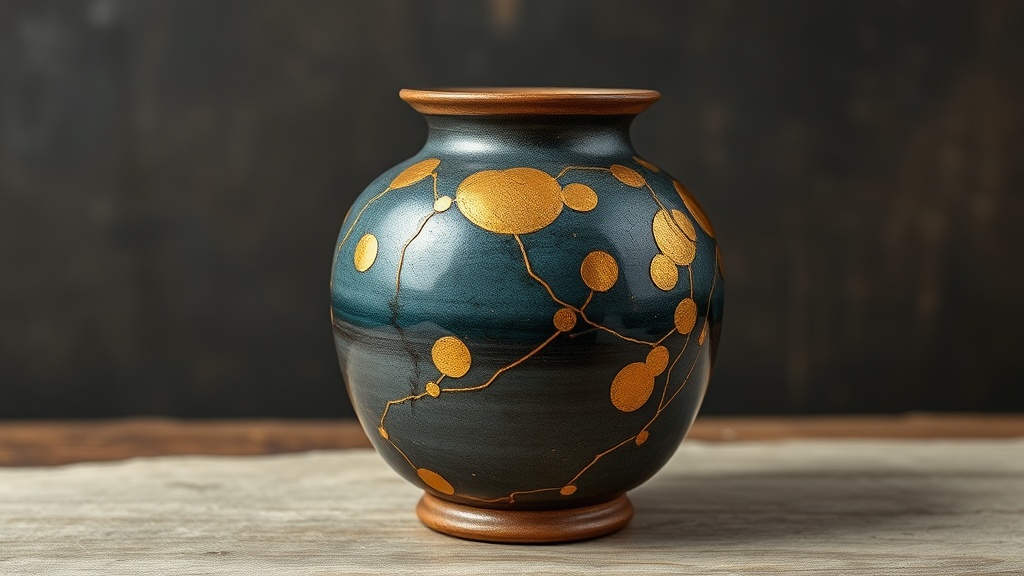
Mastering the Art of Kintsugi-Inspired Mixed Media

There is a profound, quiet magic in the broken. In the Japanese tradition of Kintsugi, broken pottery is not discarded or hidden away; instead, the fractures are repaired with lacquer mixed with powdered gold, silver, or platinum. The philosophy is simple yet transformative: the break is not a defect, but a vital part of the object's history. It makes the piece more beautiful and more resilient than it was before it shattered.
In my own practice, I have often used this concept as a metaphor for the messy, non-linear nature of healing. During my college years, when my anxiety felt like a physical weight, I used to try to make "perfect" art. I wanted clean lines and flawless color transitions. But perfection is a lie that stifns creativity. I eventually learned that the most honest art comes from the cracks—the moments where we fail, where the ink bleeds, or where the paint peels. Today, I want to teach you how to translate this ancient philosophy into your mixed-media journal through Kintsugi-inspired techniques.
The Philosophy of the "Beautiful Scar"
Before we touch a single brush, we must shift our mindset. Kintsugi-inspired mixed media isn't about fixing a mistake; it is about celebrating the fracture. In art journaling, this might mean taking a page you absolutely hate—a page where the colors muddy or the composition feels "off"—and using it as the foundation for something spectacular. Instead of ripping it out, we are going to highlight the "damage."
This approach is a form of radical self-acceptance. When you allow yourself to make "ugly things," you strip away the paralyzing fear of failure. You are telling yourself: "Even if this goes wrong, I have the tools to make it meaningful."
Gathering Your Toolkit
To execute this look, you don't need expensive gold leaf, though you can certainly use it. We are going to use a variety of textures and metallic elements to mimic the look of gold-filled cracks. You can find many of these in your junk drawer or scrap bin—don't forget that unexpected household items can make incredible art supplies.
Essential Supplies:
- A "Broken" Base: This could be a heavy watercolor paper, a piece of torn cardboard, or even a dried acrylic painting that has been intentionally cracked.
- Metallic Mediums: Gold acrylic paint, metallic liquid liners, or even a high-quality gold gel pen.
- Texture Builders: Modeling paste, heavy gel medium, or even salt and sand.
- Fine Brushes: You will need detail brushes for the "veins" of the cracks.
- Adhesives: Matte or gloss medium to seal the layers.
- Found Objects: Thin pieces of thread, torn tissue paper, or even dried botanical elements.
Step by-Step: Creating the Fracture
There are two ways to approach this: the Structural Method (creating physical cracks) and the Visual Method (painting the illusion of cracks). I recommend starting with the Visual Method to build your confidence.
Method 1: The Visual Illusion (The Layered Approach)
This method is perfect for when you have a finished journal page that you feel "stuck" on. Instead of starting over, we will layer over the "mistakes."
- Identify the "Fault Lines": Look at your current page. Where do the colors clash? Where is the composition weak? Imagine a lightning bolt or a jagged crack running through those areas.
- Build Texture: Before adding the gold, add a bit of physical depth. Use a modeling paste or a thick heavy gel medium to create a raised, jagged line along your imagined crack. This adds a 3D element that catches the light. If you are interested in more tactile ways to build surface, you might enjoy mastering the art of palette knife texturing.
- The Gold Fill: Once your texture is dry, take your gold acrylic or gold gel pen. Carefully trace over the raised texture. If you are using liquid gold paint, try to "flood" the crack so it looks like the gold is flowing through the fissure.
- The Final Seal: Apply a thin layer of gloss medium over the gold. This gives it that high-shine, ceramic-like finish that is characteristic of traditional Kintsugi.
Method 2: The Structural Break (The Physical Approach)
This is a more advanced, tactile technique. It involves actually "breaking" your substrate to create real physical gaps.
- Prepare a Rigid Substrate: Use a thick piece of watercolor paper or a thin piece of wood/cardboard.
- The Controlled Tear: Instead of a clean cut with scissors, use your hands to tear the paper or cardboard. A torn edge is much more organic and "broken" than a cut edge.
- The Reassembly: Lay your torn pieces back together on your journal page, leaving small, irregular gaps (the "cracks") between them. Use a strong adhesive or heavy gel medium to secure the pieces down.
- Filling the Void: This is the crucial step. Use a highly pigmented gold paint or a metallic liquid liner to fill the gaps between the pieces. This creates the illusion that the pieces are being held together by precious metal.
Advanced Texturing and Color Theory
To make your Kintsugi-inspired work truly pop, you need to consider the contrast between the "broken" parts and the "repaired" parts. If your background is very busy and colorful, the gold might get lost. If your background is too muted, the gold might look jarring.
I often find that using organic, earthy tones helps the metallic gold feel more grounded. If you enjoy working with natural pigments, you might find inspiration in the alchemy of indigo or other natural dyeing processes to create a deep, soulful base for your work. The goal is to create a visual tension between the dark, textured "void" and the bright, luminous "repair."
Pro-Tip: For a more sophisticated look, don't just use gold. Try using a combination of bronze and copper. This creates a sense of depth and makes the "repair" look more weathered and ancient. If you want to experiment with how different colors interact to create these moods, I highly recommend mastering the art of color mixing to understand how to balance your metallic highlights with your base colors.
The Emotional Practice: Making "Ugly" Things
As I write this, I am reminded of a journal entry I made years ago. It was a mess of charcoal smudges and frantic, jagged lines. At the time, I thought it was a failure. I thought, "I can't even draw a straight line, I'm a terrible artist." But looking back, that page was the most important one I ever made. It was the physical manifestation of my struggle, and it was beautiful because it was honest.
When you approach your mixed-media art with a Kintsugi mindset, you are practicing a form of self-care. You are learning to look at your "cracks"—your anxieties, your mistakes, your bad days—and seeing them as opportunities for illumination. You are practicing the art of being kind to yourself when things fall apart.
Next time you feel the urge to rip a page out of your journal because it isn't "perfect," stop. Take a breath. Pick up your gold paint. Instead of hiding the mistake, highlight it. Show the world (and yourself) that there is immense beauty in the way we put ourselves back together.
"The crack is where the light gets in." — While often attributed to Leonard Cohen, this sentiment is the heartbeat of the Kintsugi philosophy and the foundation of a resilient creative practice.
Go forth and make something messy. Make something broken. Most importantly, make something that celebrates the beauty of being human.
Steps
- 1
Create Your Base Layer
- 2
Apply Crackle Medium
- 3
Apply Gold Leaf Accents
- 4
Seal the Texture